
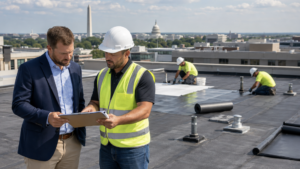
For Washington D.C. hotel owners, a flat roof is more than a building feature. It protects guest rooms, conference spaces, kitchens, mechanical systems, staff areas, and the overall reputation of the property. When a roof begins to fail, the issue can quickly move beyond maintenance and become a guest experience problem, a safety concern, and a business interruption risk. That is why understanding replacement cost matters before leaks, ponding water, or interior damage force an emergency decision.
Hotels in Washington D.C. operate in a competitive and highly visible hospitality market. The city draws business travelers, government visitors, international tourists, school groups, event guests, and families visiting national landmarks. According to the official tourism site Washington.org, the city continues to be promoted as a major destination for events, dining, museums, neighborhoods, and visitor experiences. For hotels, that means the building itself must be dependable, comfortable, and ready for constant use.
When property owners research flat roof replacement cost Washington D.C., they are usually trying to understand more than one number. They need to know what affects the price, what kind of roofing system makes sense, how disruption can be minimized, and how to protect the property long term. A hotel roof replacement is not the same as a small commercial roof repair. The scale, access, timing, guest safety, drainage, code considerations, and material choice all play a major role in the final cost.
Why Flat Roof Replacement Matters for Washington D.C. Hotels
Washington D.C. hotels often deal with a combination of older buildings, dense urban conditions, heavy mechanical equipment, rooftop units, foot traffic, seasonal storms, and high expectations from guests. A flat roof may appear simple from the outside, but it is often supporting HVAC equipment, ventilation systems, exhaust units, drainage systems, skylights, access points, and sometimes rooftop amenity areas.
The condition of that roof can directly affect operations. A leak over a guest room can lead to refunds, complaints, mold concerns, damaged finishes, and lost room availability. A leak near electrical or mechanical systems can create expensive emergency repairs. A roof that holds standing water can shorten the life of the membrane and lead to hidden deterioration beneath the surface.
Washington D.C. also has a long history of hospitality, government travel, and commercial real estate activity. The city’s importance as a national capital, described in detail by Wikipedia’s Washington, D.C. overview, makes its hotel market unique because it serves tourists, policymakers, business travelers, and convention visitors at the same time. Hotel owners are not simply maintaining a building. They are maintaining a revenue-producing property in a city where appearance, dependability, and location all matter.
What Impacts Flat Roof Replacement Cost for Hotels
The cost of replacing a hotel flat roof depends on several key factors. The first is size. Hotels usually have larger roof surfaces than standard commercial buildings, and the total square footage can make a major difference in material and labor cost. A larger roof also requires more staging, more crew coordination, more disposal planning, and more time on site.
The second factor is the existing roof condition. If the current membrane is aged but the underlying insulation and decking are still in good shape, the project may be more straightforward. If there is saturated insulation, damaged decking, poor drainage, or multiple old roofing layers, costs can rise because more tear-off, replacement, and structural correction may be needed.
The third factor is access. Many Washington D.C. hotels are located in busy areas with limited staging space, nearby sidewalks, neighboring buildings, loading zones, traffic restrictions, and tight service entrances. These conditions may require cranes, special delivery coordination, permits, safety controls, and careful debris removal. Access challenges can increase labor time and project complexity.
The fourth factor is material selection. Common commercial flat roofing systems include TPO, PVC, EPDM, modified bitumen, and built-up roofing. Each has different benefits, costs, installation requirements, and performance characteristics. Hotels may also need roofing systems that hold up well around rooftop equipment, resist punctures, improve energy performance, or support long-term warranty goals.
Why Hotel Properties Need a Different Cost Conversation
A hotel roof replacement is different from a basic commercial roof replacement because the building remains occupied. Guests may be checking in, housekeeping may be working, events may be scheduled, kitchens may be operating, and staff may need safe access throughout the project. That means planning matters as much as price.
The lowest bid may not be the best option if the contractor does not understand hospitality operations. A hotel needs a roofing team that can coordinate noise, odors, work hours, material staging, guest safety, elevator access, debris control, and communication with management. A poorly managed roof project can disrupt reviews, staff productivity, and daily revenue.
Hotel owners should also think about long-term value. A better roofing system may cost more upfront but reduce future leaks, lower maintenance needs, improve energy performance, and protect guest areas more effectively. For hospitality properties, roof replacement should be viewed as a capital improvement that protects both the physical property and the guest experience.
Washington D.C.’s hospitality industry has long been recognized as an important economic sector. The District’s Deputy Mayor for Planning and Economic Development notes the importance of hospitality and tourism in Washington D.C., including hotels, restaurants, venues, and related businesses. For hotel owners, keeping the property in strong condition supports more than the building. It supports the larger visitor economy surrounding it.
Roofing Materials Commonly Used on Hotel Flat Roofs
TPO roofing is commonly used on commercial flat roofs because it is reflective, flexible, and often cost-effective. It may be a good fit for hotels that want energy-conscious performance and a clean, bright surface. PVC roofing is another option that can offer strong chemical resistance, which may be helpful near kitchen exhaust areas or rooftop equipment. EPDM is a rubber roofing system known for flexibility and long service history, though it may not always provide the same reflective benefits as white membranes.
Modified bitumen and built-up roofing systems may also be used, especially on certain older properties or roofs that need added durability. The best choice depends on the building, budget, roof slope, drainage design, rooftop traffic, warranty goals, and existing conditions.
For Washington D.C. hotels, energy performance may be part of the conversation as well. A reflective roof system can help reduce heat absorption, especially during hot summer months. This may support interior comfort and reduce strain on HVAC systems. While roofing alone will not solve every energy issue, it can be a meaningful part of a broader building performance plan.
How Washington D.C. Hotel Market Conditions Influence Roof Planning
Roof replacement decisions do not happen in a vacuum. Hotel owners must think about occupancy cycles, tourism trends, event calendars, budget timing, and capital planning. A roofing project scheduled during a high-demand period can create unnecessary pressure. A project planned during a slower season may be easier to manage, depending on weather and contractor availability.
Recent reporting from Skift on Washington D.C. tourism and hotel tax funding highlights how visitor trends and hotel-related economics remain important topics for the District. For hotel owners, these market conditions make capital improvements even more strategic. A roof replacement is not only about preventing leaks. It is about protecting a property’s ability to compete when demand shifts.
Industry reports also show that hotel performance can vary by submarket, chain scale, and economic conditions. The Marcus & Millichap Washington D.C. hospitality market report discusses market pressures and performance expectations for hospitality properties in the region. This matters because owners may need to balance roof replacement cost with cash flow, financing, occupancy, and future renovation plans.
The Hidden Costs of Waiting Too Long
Delaying roof replacement can feel like a way to preserve cash, but it can become more expensive over time. A failing flat roof can allow water to travel below the membrane and damage insulation, decking, ceilings, drywall, flooring, lighting, and guest room finishes. What begins as a roof issue can become a building-wide repair problem.
Hotels are especially vulnerable because water damage can remove rooms from inventory. Even a small leak can lead to guest complaints, online review problems, musty odors, stained ceilings, or concerns about cleanliness. Once the guest experience is affected, the cost is no longer limited to construction. It can affect revenue, brand perception, and repeat bookings.
Waiting too long can also reduce options. A roof that could have been replaced in a planned project may become an emergency replacement. Emergency work can limit scheduling flexibility, increase disruption, and make it harder to compare contractors or choose the best system. Planning ahead gives owners more control over cost, timing, and quality.
Why Inspections and Detailed Estimates Matter
A serious hotel roof replacement estimate should include more than a quick square-foot price. Property owners should expect a detailed inspection of the membrane, seams, flashing, drains, penetrations, rooftop units, parapet walls, insulation condition, and any visible signs of moisture. In some cases, moisture scanning or core samples may be recommended to determine what is happening below the surface.
A strong estimate should explain the scope clearly. It should describe tear-off requirements, insulation replacement, deck repairs, drainage improvements, material type, warranty options, safety planning, staging, cleanup, and timeline. It should also identify potential variables that may affect the final price once the old roof is opened.
For hotels, the estimate should include an operations plan. Owners should know how the contractor will protect guests, coordinate with management, handle noise, manage odors, secure work zones, and communicate schedule changes. The best roofing decision is not just the one that looks good on paper. It is the one that protects the property while keeping the hotel functioning as smoothly as possible.
Washington D.C. Hotel News Shows the Value of Property Investment
Hotel real estate in Washington D.C. continues to draw attention because properties in strong locations can hold long-term value. Recent coverage from Axios about Hotel Harrington’s sale in downtown Washington D.C. shows how historic hotel assets remain part of larger conversations about redevelopment and future use. For current hotel owners, this reinforces a simple point: building condition matters.
Hospitality reporting from Hotel Investment Today on Washington D.C. recovery and hotel development also points to ongoing movement in the D.C. hotel market, including performance trends and development activity. In that kind of environment, property owners who maintain major building systems are often better positioned to protect value and compete for guests.
A roof may not be the most visible part of a hotel, but it affects almost everything below it. Strong roofing helps protect renovations, lobbies, guest rooms, restaurants, meeting spaces, back-of-house operations, and mechanical systems. It also helps owners avoid the kind of emergency repair cycle that can drain budgets and distract management.
Conclusion
Flat roof replacement cost for Washington D.C. hotels depends on size, access, material choice, existing damage, drainage, rooftop equipment, labor, safety needs, and the complexity of keeping an occupied hospitality property running during construction. While every hotel is different, the most important decision is to treat the roof as a long-term business asset rather than a simple maintenance expense.
For property owners, the right roofing project should protect guests, preserve revenue, support building value, and reduce the risk of future disruption. A well-planned replacement can help prevent leaks, improve performance, and give hotel management more confidence during storms, busy seasons, and high-occupancy periods.
Washington D.C. is a demanding hotel market, and guests expect properties to feel clean, safe, comfortable, and well cared for. Replacing a failing flat roof at the right time helps protect that experience. For hotel owners, the smartest approach is to get a detailed inspection, understand the full scope, compare roofing systems carefully, and choose a contractor who understands both commercial roofing and the realities of hospitality operations.