
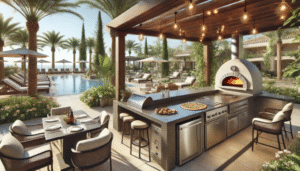
Hotels win when they create memorable, shareable moments that keep guests on property longer and inspire repeat stays. Few amenities do that as effectively—as profitably—as a well-designed outdoor kitchen. Picture it: wood-fired aromas drifting across the pool deck, a chef searing local seafood at sundown, guests lingering with spritzes under string lights while a small plate menu keeps spend flowing. That’s not just ambiance—that’s a revenue engine, a brand differentiator, and a guest-satisfaction magnet. In a year when the industry is competing fiercely for leisure and group dollars, an outdoor kitchen can pull double (and triple) duty across dining, events, activation programming, and social content. 🌅📸
Below is a practical, business-minded case for adding an outdoor kitchen to your hotel—how it boosts revenue, amplifies guest experience, supports group business, and pays off operationally with the right design and programming.
Revenue Beyond Rooms: A Powerful Ancillary Engine 📈
Rooms will always be the foundation, but smart hoteliers are widening the lens to total revenue. Industry data shows rooms typically make up about two-thirds of total revenue, leaving a sizable one-third from “other” departments—food & beverage, spa, parking, etc. That non-rooms slice is where an outdoor kitchen thrives. STR’s guidance on total revenue management notes rooms account for ~68% of total revenues on average, underscoring the importance of optimizing ancillary lines. STR
Meanwhile, branded research and market commentary continue to point to a positive (if measured) outlook—conditions that reward high-margin, experiential amenities that keep spend on property. The American Hotel & Lodging Association’s 2025 State of the Industry outlines a robust development pipeline and evolving cost pressures—evidence that owners are still investing, but must invest wisely. An outdoor kitchen that reliably generates F&B, banquet, and event dollars fits that mandate. Read AHLA’s 2025 report (PDF). AHLA
Elevate Guest Experience (and ADR) With Taste-Forward Moments 😋
Travelers are seeking culinary experiences, not just meals. An outdoor kitchen unlocks:
-
Chef-led theater: Live grilling, wood-fire, or plancha stations deliver the “I was there” factor.
-
Regional storytelling: Spotlight local farms, fisheries, and purveyors through seasonal, open-air menus.
-
Programming that sells: Think rosé-on-the-roof Fridays, taco & mezcal nights, oyster shucks, pasta-al-fresco classes, or brunch on the terrace.
Experiential F&B is a strong lever for rate justification: guests happily pay a little more for an immersive stay that feels like a mini-festival of flavors. Industry trend lines around “experience over things” and outdoor, nature-linked offerings bolster this approach; Skift Research has repeatedly tracked the shift toward more experience-rich hospitality. See Skift’s coverage of evolving luxury and nature-forward experiences. Skift
A Catalyst for Groups, Weddings, and Social Events 💍🎉
Your outdoor kitchen isn’t just a restaurant add-on—it’s event infrastructure. With a flexible layout (service counter + grill + prep + pass), you can run:
-
Welcome receptions with passed bites hot off the grill
-
Wedding after-parties featuring late-night sliders and s’mores bars
-
Corporate team-builders (pizza-making competitions, chef demos)
-
Pop-up markets with local chefs or breweries
Group business has been powering banquet and catering strength across many markets, and with it, the labor and menu strategy must adapt. STR commentary highlights how F&B labor dynamics are shifting as banqueting returns; smart outdoor setups streamline throughput while preserving spectacle. STR And in CBRE’s analysis of F&B performance, department profits surged when offerings and efficiencies were recalibrated—proof that thoughtful concepting and operating models matter. CBRE on F&B performance and margins. CBRE
Keep Guests On-Property Longer (and Spending Happily) 🥂
The classic challenge: guests check in, then leave to dine off-property. An outdoor kitchen changes that behavior by providing a destination within your destination. When the food is craveable, the views are photogenic, and the vibe feels local yet polished, guests linger—ordering another round, adding a dessert, and booking cabanas the next day. The ripple effects include:
-
Incremental F&B (shareables, signature drinks, desserts)
-
Retail tie-ins (house rubs, sauce kits, branded glassware)
-
Amenity cross-sell (pool seating, spa, late checkout)
A strong on-site culinary scene also supports reputation and organic distribution via social—guests become your best influencers when the backdrop is sunset, firelight, and a chef at the grill. 🌇
Design That Works: From Instagrammable to Operable
A beautiful outdoor kitchen still has to run like a machine. Keep these principles front and center:
-
Flow & zoning: Separate guest interaction zones (chef counter, carving station) from back-of-house prep and dish return paths to minimize cross-traffic.
-
Heat & smoke management: Choose equipment (e.g., gas/induction + strategic use of solid fuel where permitted) with proper hooding/ventilation per local code.
-
Speed rails & pass-throughs: A clearly defined pass reduces plate dwell times and keeps temperatures consistent.
-
Menu engineering for outdoors: Prioritize items that hold heat, travel a short distance, and don’t bottleneck the line.
-
Sound, sightlines, lighting: Warm, layered lighting with focused task lights at the pass; ambient sound that complements—not battles—live cooking.
-
Weatherproofing: Overhead protection, wind screens, and radiant heat extend shoulder seasons; misters in high-heat markets protect staff and comfort.
-
Accessibility & inclusivity: Counter heights, circulation space, and seating that welcome all guests.
Sustainability and Efficiency Wins 🌿
An outdoor kitchen can be both experiential and efficient. Induction planchas, energy-smart refrigeration, and water-wise cleanup cut utilities and reduce heat exposure for staff. Thoughtful sourcing (local, seasonal) lowers transport miles and supports your ESG narrative for groups and corporate RFPs. Hospitality education hubs have noted the compounding benefits of smart, sustainable operations—from lower energy usage to increased guest preference. EHL’s hospitality insights on sustainable tech and cost savings. Hospitality Insights
Staffing, Training, and the New F&B Reality 👩🍳
Outdoor concepts work best with cross-trained teams who can flex between banquets, outlets, and activations. Build in:
-
Prep discipline: Mise en place in BOH to keep the outdoor line lean.
-
Service choreography: Define roles for greeters, runners, expo, and on-mic chef personalities.
-
Menu guardrails: High-impact, low-complexity SKUs during peak windows; expand only when labor and demand justify it.
As industry notes, F&B labor dynamics remain a key pressure point; aligning your menu and service model with staffing realities is a must. STR flagged a notable rise in F&B labor costs as banqueting rebounds; design and menu choices can mitigate those pressures. STR
Marketing the Moment: Make It Easy to Say “Yes”
Don’t just build it—program it. Promote named nights (e.g., “Coastal Fire Fridays”), limited-run chef collabs, and seasonal pairings. Package room + culinary experiences (two spritzes + terrace tapas), and drop limited seatings to create urgency. Encourage UGC with subtle photo-ready “moments” (neon phrase on brick, signature dish served in a skillet, a dramatic finishing step like torching or carving tableside). Tie in the loyalty program—bonus points for outdoor-kitchen spend during shoulder season keeps locals and staycationers in the mix.
Risk, Codes, and Practicalities (So You Sleep at Night)
-
Local codes & permits: Ventilation, grease management, fire suppression, fuel storage, and staffing certifications vary—bring your architect and local AHJ in early.
-
Neighbors & noise: Directional speakers, hour policies, and acoustic baffling maintain community goodwill.
-
Weather plans: Pre-wired temporary enclosures, mobile heaters, and lightning protocols ensure continuity.
-
Supply continuity: Redundant refrigeration and warming to protect service during peak; backup SKU plans for shorts.
ROI: Where the Payback Comes From
Outdoor kitchens generate returns across multiple lines:
-
Direct F&B: Premium shareables, live-fire mains, and beverage programs with healthy per-cover averages.
-
Group & social: Higher capture for receptions and weddings; new rental fees for private use.
-
Rate support: Elevated experience = stronger ADR defense on peak dates.
-
Length of stay & on-property spend: Guests who dine on site are likelier to book cabanas, spas, and late checkouts.
-
Brand & PR: Chef collabs and local partnerships create earned media hooks that a standard buffet never will.
Industry analyses show how recalibrated F&B strategies and efficiencies materially improve departmental profitability—evidence your capex can return quickly when paired with the right operating model. Review CBRE’s findings on F&B profit expansion. CBRE And as macro travel demand trends skew toward richer experiences, properties that stage high-touch, outdoor culinary moments are well-positioned to capture discretionary spend. Skift’s experience trendline. Skift
Implementation Roadmap: From Idea to First Service 🚀
-
Concept & positioning
Decide the culinary angle (live-fire coastal, garden-to-grill, Asian charcoal, Southern smoke & small plates). Anchor it to your market story—not a generic rooftop cliché. -
Space plan & equipment
Right-size line equipment to projected covers; prioritize speed-of-service stations, a tight hot line, and a clearly lit pass. Engineer ventilation and grease capture early. -
Menu engineering
Short, craveable, operationally sane. Price for value and velocity. Build in a small “showtime” item to juice social feeds. -
Labor model & training
Cross-train a lean team; define roles by daypart (daytime resort casual vs. evening elevated). -
Programming calendar
Lock a quarterly cadence of themes, collabs, and group-friendly packages before you open. -
Marketing & partnerships
Pre-sell with local purveyors, wineries, or breweries; invite micro-influencers to soft-openings with a simple content brief. -
Metrics & iteration
Track capture rate, check averages, speed-of-service, waste, and guest sentiment; adjust quarterly. (Industry watchers—from STR to CBRE—underscore how agile F&B strategies can protect margins while delighting guests.) STRCBRE
Conclusion
An outdoor kitchen is far more than a pretty patio—it’s a multiplier for revenue, guest delight, and brand storytelling. It keeps travelers on property, creates reasons for locals and groups to gather, and delivers the kind of culinary theater that lights up social feeds and review sites. In a market that rewards authentic experiences and disciplined operations, investing in an outdoor kitchen is one of the smartest ways to differentiate, deepen loyalty, and grow total revenue in 2025 and beyond. 🍷🔥